
Angus Hanton
Swift 2024 £25.00
A 10-minute drive from the North Queensferry home of former Labour Prime Minister Gordon Brown is the second-largest Amazon “fulfilment centre” in the United Kingdom. Long in the planning during New Labour’s years in government, its 1.5 million square-foot premises opened the year after Brown retreated from No 10 Downing Street to a home overlooking the world-famous Forth Rail Bridge.
Last Christmas Brown was reported as working very closely with Amazon in his “Winter Survival Appeal”. Speaking to the Evening Standard, Mr Brown spoke passionately about the penury he sees in his Fife former constituency. He said: “The level of poverty is something I never expected to see again in my lifetime. The last time I saw this sort of poverty was growing up in a mining, industrial town where there was a great deal of social housing and a great deal of distress. I thought we would never go back to those days again.”
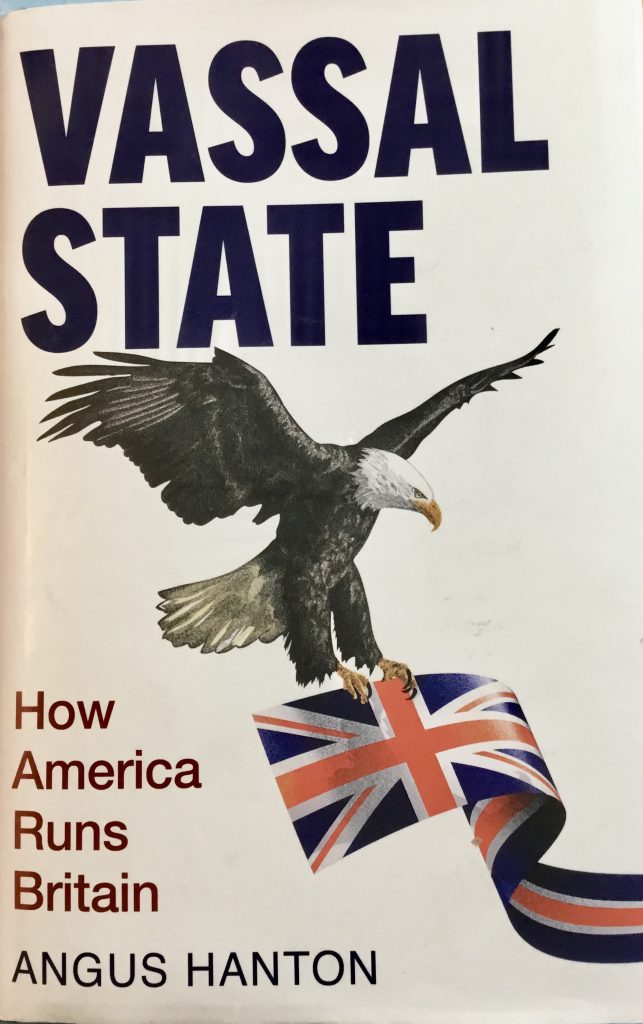
In Vassal State Angus Hanton carefully traces the links between the Amazon global activities of US multi-billionaire Jeff Bezos and the impoverishment of millions, including Brown’s former constituents.
Even nearer to Brown’s home beside the Forth is Rosyth, the former Royal Navy dockyard privately owned by Babcock & Wilcox. Hanton tells how British medic and inventor Ian Walker, on a tour of the engineering company while professor of obstetrics at Glasgow University in 1955 “was showed a sound-wave device for finding flaws in steel welds, and he noticed the operative tested it by bouncing sound waves off the bones of his thumb.
“Donald immediately started work on adapting the technology for medical use, and by June 1958 his team had built their own imaging machine and published pictures of a 14-week-old foetus. Although in its infancy, ultrasound scanning had been born. Today, GE Healthcare, of Chicago, is the market leader supplying the NHS.”
This is just one of many similar stories that can be told of the British failure to turn innovatory discoveries and inventive ideas into marketable products, so Hanton doesn’t need to rehearse this sadly familiar saga at length. Instead, he details how America has harnessed innovation so effectively.
The author ranges from medical supplies and pharmaceuticals to Meta and Google, and from banks and travel companies to foodstuffs and Apple in showing how US corporations own and effectively control the British economy. They do so as they siphon off large profits while paying little or no tax.
“When British politicians say they cannot afford to reduce hospital waiting lists or that they are compelled to increase personal tax rates, some of this is a direct result of their failure to collect tax from the multinationals.
“The British government has followed a dysfunctional approach to international tax: the so-called ’arms-length’ principle. This means that affiliates of a multinational group are taxed as if they were independent entities and allows them to siphon off royalties or fees for services to other subsidiaries, often offshore.”
He continues: “Big US tech is particularly unlikely to pay significant UK tax: Google and Microsoft at points have house their IP [intellectual property] units in tax havens and then charged their subsidiaries significant royalties for using the company’s IP – such as software, branding and patents. A popular place for the big companies to put their IP rights is the Cayman Islands, a territory with no corporation tax, or Switzerland, where earnings from royalties can be taxed at rates as low as 2 per cent.”
It’s not just tax havens: “As well as offshoring profits, big US corporations are experts at exploiting any legal loopholes or allowances they can find and have the resources to do it – in contrast to the cash-strapped HMRC and its civil servants.”
Hanton spells out in plain language the consequences of the UK allowing free riders.
“The trouble with tax is that when someone does not pay their fair share, everyone else has to pick up more of the bill. It follows that the very low tax payments by US multinationals mean there is less money for infrastructure upgrades, and local people have to shoulder a correspondingly heavier burden. Worse, there are specific parts of the UK infrastructure where US corporations are really heavy users, making the running costs higher and raising the amount required from everyone else.”
Anyone seeing the number of heavy vehicles passing in and out of the huge Amazon warehouse near Brown’s home will realise how dependent the Bezos empire is on the local road network.
“Yet its road tax payments fail to cover the costs of its road usage, partly because lorries are significantly more damaging to the environment than other vehicles, and because Amazon’s vehicles do above average mileage – typically 100,000 miles a year…. Now consider Amazon’s packaging – along with that of other online retailers. Amazon generates tons of cardboard and plastic, which are fed into the UK waste network and dealt with by local authorities across the country. These are also subsidised through general taxation.”
Hanton writes: “There is an additional and critical cost to which US multinationals are not contributing their share. That is the cost of running the British state. Their businesses rely on a stable government, law and order, the protection of their property and IP rights, sound money, viable national defence and a social security system – to all of which they are making only a small contribution.
“Bit by bit, you can trace a pattern of policy decisions by the UK government and ingenious choices by the US government and US corporations that work against ordinary taxpayers in the UK. Large companies can revel in the fact that about 80 per cent of UK tax is collected from taxes on individuals; payroll taxes (income tax and National Insurance), property taxes (council tax and stamp duty) and sales taxes (VAT and excise duty).
“Less than 8 per cent of UK government revenue comes from corporation tax, of which multinationals pay only a small fraction. The new global tax deal won’t change that significantly, so the multinationals will continue their free ride while the UK government demands that its citizens pick up the tab.
“It is fair to ask whose interests are served by this and whether this allows for adequate funding of the things that matters most to the British people – chief among them the NHS.”
Hanton relentlessly charts the large areas of British life deeply penetrated by US business, but not in any accusatory anti-American way. He admires the hard work, creativity and level of investment which has produced the postwar US economy.
“In total, the US spends 3.4 per cent of its GDP on R&D [research and development] – which for many years was double the UK’s rate. But the actual numbers are stark. In 2020, the US spent $717 billion, while the UK spent only a tenth of that – some $90 billion.”
The author continues: “Backed by the largest economy in the history of the world, staffed by managers who train and compete for supremacy over decades, US corporations approach efficiency with scientific ruthlessness and patiently invest time and resources to dominate their competition. And British businesses have struggled to compete with these engineers of process and finance. Even when Britain’s’ businesses achieve dramatic innovation and create popular products or services, US corporations can out-compete them or are allowed to just buy them up.
“They have found ways to build their profits with treadmills and inertia, with monopolies and mergers, and through borrowing and squeezing. While US corporation may not have consciously planned to turn Britain into a vassal state, the effects of their commercial prowess, combined with UK policymakers’ open-armed welcome, has produced exactly that result.”
The author, in his concluding paragraphs headed “The struggle for values”, writes: “The analysis of this book… forces us to reinterpret the historical significance of Margaret Thatcher, an ardent Atlanticist. While she is mostly credited with reducing the role of the state, cutting the power of trade unions and promoting private enterprise, her more lasting legacy is the wholesale transfer of British assets to new American owners, something she instigated.
“If she were alive today, Thatcher would be shocked by how much of the economy is US-owned and how servile the UK government has become, yet it was she who made it all possible through her strong advocacy of privatisations that were blind to the nationality of the buyers, and her general non-interventionist stance.
“She might also be horrified to see how her idea of ‘popular capitalism’, with citizens as shareholders, has collapsed, with private shareholdings shrinking year by year. In her second full year in office, 1981, only 3.6 per cent of UK shares were owned overseas. By 2020 that number was more than 56 per cent.”
Hanton is not the first person in Europe to identify the power of the United States. Jean-Jacques Servan-Schreiber was one of the earliest to identify it in his 1967 The American Challenge. But no one, to my knowledge, has detailed its contemporary consequences for Britain in more devastating detail. It is a book that should be read and acted upon by those who nominally rule this country – but I’m not holding my breath.
If you would like to be notified by email of new posts please sign up to my mailing list